
Franklin County’s Public Wanted List
The sheriff's office keeps its warrant work largely behind the scenes. The patrol page describes deputies serving arrest warrants, and a companion investigations page covers the work of tracking down wanted people. Neither adds up to a public list. There is no roster to browse, no photo policy, and no update schedule to check.
That gap matters. A curated wanted notice is not a catalog of every active warrant, and someone can be named in court process without appearing anywhere public. Old pages also linger, showing a status long after a warrant has been served or recalled. The court or issuing agency holds the current answer.
The image below comes from the FCSO investigations side of the site. Treat it as agency background, not a face gallery.
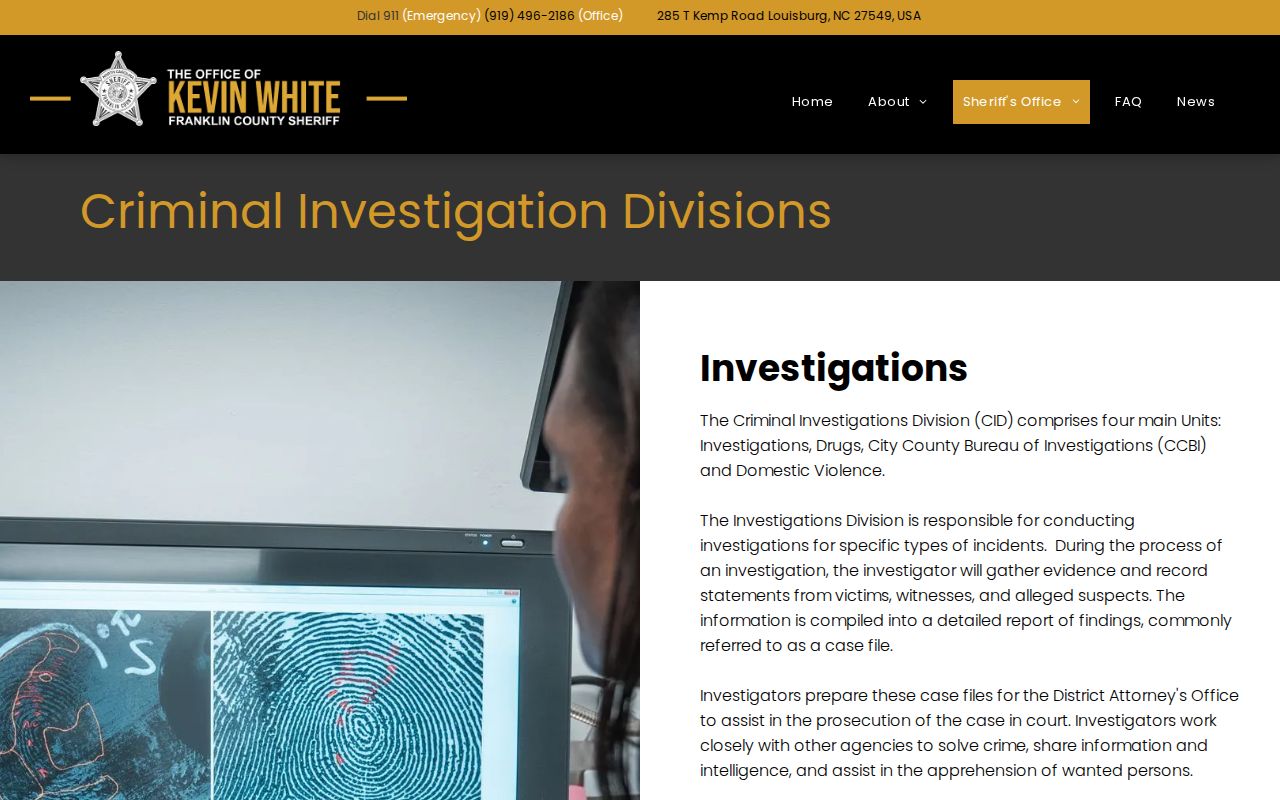
The investigations page helps explain what the agency does. It just does not include a current wanted roster, so there is nothing to verify against it.
What a Wanted Notice May Show
No published list is in hand. So learn what an official notice would contain if one appears. Names matter. So do the charges, the issuing agency, and the dates. A third-party page copying that material may drift from the source, so check the original before trusting anything.
| Field | How to read it |
|---|---|
| Name and identifying details | Use enough detail to distinguish people with similar names. Do not publish or repeat protected information without a clear need. |
| Alleged offense or process | Describes the charge or warrant basis. It is not a finding of guilt. |
| Agency and case reference | Shows which office may confirm the notice and which court file may contain related events. |
| Date posted or updated | Shows how current the notice may be. A page without a date deserves extra caution. |
| Photo or description | An identification aid only. It can be old, incomplete, or mistaken. |
| Tip method | Use the listed official line or form. Never follow, confront, or try to detain the person. |
One detail deserves special attention: status. Active, served, recalled, and unconfirmed process are different things. A page that lumps them together is a lead and nothing more. For any specific person, the court and the issuing agency keep the better record.
How to Read Franklin County Wanted Information
When an official notice or court event is in front of you, work through it in this order:
- Check that the page is on an official FCSO or court domain and note its posted or updated date.
- Read the complete name, alleged offense, agency, and identifying description without relying on a photo alone.
- Search the person’s public court trail in NC Portal, then compare the case number or event where available.
- Ask the Franklin County Clerk or issuing agency to confirm whether the process is active, served, unserved, recalled, or otherwise changed.
- If you have information about a person’s location, use the FCSO tipline or online form. Call 911 for an emergency.
An online notice is not a personal case to solve. Report what you know. Let law enforcement make the contact.
For someone already booked rather than currently wanted, the countywide Franklin County records guide sorts out the difference. Current custody, a released booking, a court case, and a state custody record each sit in a different place.
United for Safety Tip Route
The United for Safety page gives Franklin County residents two ways to report. The phone line is 919-514-9577. The online form asks for email, phone, a message, and the date and time of the occurrence. FCSO says a tip can earn a reward. That reward applies when the tip helps lead to an arrest, the recovery of stolen property or illicit items, or the capture of a fugitive. The page makes no promise of anonymity, so do not count on the form to keep your name out of it.
Franklin County Sheriff's Office tip contact (Sheriff Kevin White)
United for Safety line: 919-514-9577
Online tip form
Emergency: 911
A tip passes information to the agency. That is all it does. It will not confirm a warrant, fetch a booking photo, or authorize you to confront anyone described in a notice.
Follow the current instructions on the tip page for the smoothest route. The form may request contact details, and nothing on it guarantees confidentiality.
Warrant Check Through Court Records
No countywide public warrant portal exists at FCSO. The stronger official path runs through North Carolina's court records, with confirmation from the Franklin County Clerk or the issuing agency. The NC Portal offers public docket and hearing searches. Its Register of Action may show events such as a warrant issued, served, unserved, or recalled when that information is available.
Keep the Portal in perspective. It is not the official court file, and a public entry can lack context. Updates may lag behind real changes. When the answer affects a court appearance or a legal decision, call the Clerk or an attorney. The Franklin County Clerk sits at 102 S Main Street, Louisburg, NC 27549. For a bond-refund question, one number printed by FCSO is 919-497-3030, though routing varies by clerk division.
Court events and jail bookings answer different questions. A warrant can end in an arrest. But a summons, citation, or other process can arrive with no Franklin County booking photo at all. If an arrest does enter county custody, FCSO holds the local booking path. After release, the booking stays a records matter even though current custody no longer shows.
Warrant Types Need Confirmation
Online pages love broad labels. The exact process, court, and issuing agency decide what a label means in a particular file.
| Record label | Safe reading |
|---|---|
| Arrest warrant | Judicial process alleging a basis for arrest. It is not a conviction. |
| Bench warrant | A court-related process that can follow a missed appearance or other event. Confirm the underlying docket with the Clerk. |
| Order or process event | A Portal entry that may need court context before it can be understood. |
| Served, unserved, or recalled | Status language that should be confirmed because a web docket may not be complete or current. |
The patrol and investigations pages do confirm the agency serves warrants. But neither one posts a public count or list. So there is nothing to interpret here. Guessing at a roster size, a date, or a person's status would just be invented. Skip it.
Safety Before Any Warrant Tip
Do not approach. That single rule matters more than any other. Skip the confrontations, the following, the threats, and the amateur detective work. If danger is unfolding right now, call 911 instead of hesitating. Otherwise, pass along what you know through the tip route the Franklin County Sheriff's Office has published.
Think a warrant might have your name on it? Call the court, a lawyer, or the issuing agency. Nobody should decide whether to appear, surrender, or travel based on an online page alone. Name matches deserve the same caution. A shared name can point at the wrong case, and an old booking image that still circulates online may have nothing to do with a person's current status.
Franklin County's public pages offer no live roster. You cannot check counts, update times, or status changes there. So treat a reposted photo, a search hit, or a social media share as a lead. Nothing more. Before repeating anything, confirm the date, agency, case number, and court. Verification matters even more when several agencies touch one case or the name is common.
The courts and the Sheriff's Office also describe the same process in different terms. A docket event might show a warrant issued or recalled. The agency holds the service details. A portal can help you find a case, but the Clerk's file remains the real record. Going straight to a legal or court contact is safest, since staff there can explain appearance and filing options. And keep the tip line for facts that help officers, not for settling private disputes.
Wondering whether someone is in custody right now? Use the detention and custody routes on the Franklin County Busted Mugshots home guide. Wondering what happened in court? Go through the NC Portal and the Clerk. Keeping those two questions separate stops a warrant lead, a booking record, and a court outcome from blurring into one.